El FIRST Robotics Competition mostró el sábado pasado lo que es el juego por el torneo esto año. El juego se llama FIRST Stronghold y tiene una tema medieval. Los robots tiene tareas diferentes. Por ejemplo hay pelotas para poner en metas. También hay defensas para romper y una torre para subir. Un video sobre el reto esta en el sitio: https://youtu.be/OWJLe_WtZxI
He escuchado de muchos estudiantes y mentores que ellos son muy emocionados sobre el juego y tema esto año. Yo también pienso el juego será interesante y divertido con las muchas tareas, pero después de vi el juego pensaba si vale la pena? Esto juego parece más complicado de en años anteriores con ambos las reglas y el terreno del juego. En el terreno hay muchos tipos de defensas y muchas luces y tecnología complicada para regular todos. Esto juego necesita un muy costoso terreno. Pueden los equipos sin mucho dinero tener éxito si no pueden construir el terreno para practicar? Entiendo todos detalles del juego inspiran los niños en tecnología pero en vez de eso sería mejor a intentar a desarrollar un juego menos complicado y menos costoso para que más niños del mundo pueden participar? La tarifa por el torneo es más o menos 20000000 pesos colombiano, entonces la oportunidad a participar en el FIRST Robotics Competition por los colombianos es disfortunadamente muy raro aunque sería también una buena programa por ellos.
Wednesday, January 13, 2016

Sunday, January 3, 2016
Robótica en Colombia
Estoy de nuevo en América latina. Por pocas semanas estoy en Colombia para conocer equipos de robótica acá. La última semana estuve en Medellin y conocí un maestro de clases de tecnología en un colegio allá. El ha intentado hace tres años que su equipo de robótica participar en el torneo del FRC (FIRST Robotics Competition). FRC son torneos lo que empezaron en los Estados Unidos y hoy hay equipos en muchos países que participan. Estudiantes de colegios diseñan y construyen un robot en seis semanas por uno de los torneos que son en primavera. Este sábado todos equipos van a conocer el juego por este año y que el robot tiene que lograr. Espero que el equipo de Medellin lo que conocí tenga mucho éxito este año. He visto cuatro o cinco equipos de Colombia han registrado por el torneo y intento en mi viaje a conocer más de ellos.
Tuesday, March 31, 2015
Windenergie aus München
Here's a post I drafted almost two years ago, but am just getting around to posting. My new blog entries are now moved to https://dieingenieurinaufdeutsch.wordpress.com/.
--------------------------------------------------------------------------------------------------------
Cada mañana, yo desayuno y veo una turbina eólica en la vista de mi balcón. Por fin, decidí a apprender mas de eso turbina en el internet. La turbina esta en la montaña de Fröttmaning y puede hacer 1.5 MW de energía. La gente puede verlo encima de la montaña y es una symbol ecológico de Munich para promocionar technologias renovables.
Jede Tag, esse ich mein Frühstück und sehe ich eine Windkraftanlage in die Ansicht von meinen Balkon. Endlich habe ich mehr von der Turbine in das Internet gelernt. Die Turbine ist auf Fröttmaninger Berg und es macht 1.5 MW Energie. Leute können auf den Berg es sehen. Es ist eine ökologisches Wahrzeichen für grüne Technologien in münchen.

Quiería saber mas de la turbina. Entonces tomé una viaje para visitarlo! El cerro es solo algunas kilometros de mi piso, entonces era una buena viaje con bicicleta. Cuando estaba circa del cerro, podia ver la turbina porque es la unica cosa arriba, encima del cerro.
Ich habe mehr wissen gewollt. So habe ich eine Reise zu die Windkraftanlage gemacht! Der Berg ist nicht so weit weg von meine Wohnung so es ist eine gute Reise mit meinem Fahrrad. Wann war ich nah von die Turbine, ich habe es oben auf dem Berg gesehen.


(las ultimas dos fotos de wikipidia.de)
--------------------------------------------------------------------------------------------------------
So in English, in brief: There's a wind turbine on Fröttmaninger hill that I watch from my balcony everyday. It's a 1.5 MW turbine that serves as a kind of symbol for renewable energy in Munich, where cars pass by and see it and people can visit too. I rode my bike to the turbine, and there were a few infomation boards promoting the turbine and renewable energy in general. One really cool project called the South Star involved the turbine in December 2009, where it was lit up with 9000 LEDs to become the "biggest Christmas star in the world." This project was conceived as a result of the UN Climate Conference in Copenhagen.
--------------------------------------------------------------------------------------------------------
Cada mañana, yo desayuno y veo una turbina eólica en la vista de mi balcón. Por fin, decidí a apprender mas de eso turbina en el internet. La turbina esta en la montaña de Fröttmaning y puede hacer 1.5 MW de energía. La gente puede verlo encima de la montaña y es una symbol ecológico de Munich para promocionar technologias renovables.
Jede Tag, esse ich mein Frühstück und sehe ich eine Windkraftanlage in die Ansicht von meinen Balkon. Endlich habe ich mehr von der Turbine in das Internet gelernt. Die Turbine ist auf Fröttmaninger Berg und es macht 1.5 MW Energie. Leute können auf den Berg es sehen. Es ist eine ökologisches Wahrzeichen für grüne Technologien in münchen.

Quiería saber mas de la turbina. Entonces tomé una viaje para visitarlo! El cerro es solo algunas kilometros de mi piso, entonces era una buena viaje con bicicleta. Cuando estaba circa del cerro, podia ver la turbina porque es la unica cosa arriba, encima del cerro.
Ich habe mehr wissen gewollt. So habe ich eine Reise zu die Windkraftanlage gemacht! Der Berg ist nicht so weit weg von meine Wohnung so es ist eine gute Reise mit meinem Fahrrad. Wann war ich nah von die Turbine, ich habe es oben auf dem Berg gesehen.

Encima del cerro, hay mas infomacion de la turbina.

Una cosa mas que es bien chévere de esta turbina. En diciembre de 2009, era en un proyecto se llama estrella de el sur, y era "la mejor estrella de la navidad en el mundo." Mas o menos 9000 ledes estaron en los alabes de la turbina y cuando era oscuro en las noches y la turbina volaba, haria un bien chévere estrella! Eso era importante a promocionar un reunion de cambio de clima en Copenhague en eso año.
Es gibt einen tollen Fakt üben die Windkraftanlage. Es gab ein Projekt in der Dezember von 2009 heißt Stern des Südens und das war den „größten Weihnachtsstern der Welt“.


(las ultimas dos fotos de wikipidia.de)
--------------------------------------------------------------------------------------------------------
So in English, in brief: There's a wind turbine on Fröttmaninger hill that I watch from my balcony everyday. It's a 1.5 MW turbine that serves as a kind of symbol for renewable energy in Munich, where cars pass by and see it and people can visit too. I rode my bike to the turbine, and there were a few infomation boards promoting the turbine and renewable energy in general. One really cool project called the South Star involved the turbine in December 2009, where it was lit up with 9000 LEDs to become the "biggest Christmas star in the world." This project was conceived as a result of the UN Climate Conference in Copenhagen.
Tuesday, October 29, 2013
Presentation on "Engineers solve the problems of the world"
I made this talk I made to deliver to a high school class on "Introduction to Engineering." In it, I detail some of my adventures as an engineer through Latin America, hoping to inspire the next generation of engineers and problem solvers who will make our world a better place.
Engineers solve the problems of the world
Engineers solve the problems of the world
Tuesday, July 30, 2013
Promoting wind energy
In the weeks before the Guiness World Record installation and during the installation itself, there was a great deal of media attention for this project. WindAid was in the Peruvian news, including TV and newspapers. This just goes to show that breaking a world record is one way to bring the public’s attention to not only renewable energy, but also climate change. Here are some links:
Instalarán turbina de viento más alto del mundo en nevado Pastoruri (Récord Guinness)
Installation of highest wind turbine gets a mention in the World Guinness Book of Records
HUARAZ INSTALAN GENERADOR DE ENERGÍA ELÉCTRICA EN EL NEVADO PASTORURI

Instalarán turbina de viento más alto del mundo en nevado Pastoruri (Récord Guinness)
Installation of highest wind turbine gets a mention in the World Guinness Book of Records
HUARAZ INSTALAN GENERADOR DE ENERGÍA ELÉCTRICA EN EL NEVADO PASTORURI

Monday, July 8, 2013
The highest altitude wind turbine in the world
Last month WindAid embarked upon a project to break a
Guiness World Record of the highest altitude wind turbine in the world. This installation was done at the entrance to
the Pastoruri Glacier in the state of Ancash of Peru, at the elevation of 4882
meters. This wind turbine installation
achieves several things. It provides
electricity to the two women who live there, such that they are able to have
light in their homes after dark. Also,
it provides electricity for the nearby buildings, some of which serve as places
to sell souvenirs for tourists visiting the park. None of this area has had electricity
before. This project to put the highest
altitude wind turbine in the world at this park also provides more publicity
for wind energy in Peru and also brings more attention to the melting of the
Pastoruri Glacier, and this attention will hopefully lead to more renewable
energy and actions to prevent glacial melt in the future.
La mes pasada WindAid empezó un proyecto a romper un Record
Guiness por la turbina eólica mas alto en el mundo. Esto instalación estuvo en la entrada de la
Pastoruri glacier en el estado de Ancash en Perú a 4882 metros alto. Esto instalación es para algunos cosas. Da electricidad para las dos mujeres que
viven allá para que ellas pueden tener luz en su casa cuando oscuro. Tambien esto da luz para los otros edificios
cerca que usan por vender cosas para turistas y otras funciones. Todos estos edificios y casas nunca han
tenido luz antes. Esto proyecto tambien
hace mas publicidad para energia eólica en Perú y tambien mostra el mundo de la
deterritido de Pastoruti. Esperamos que
esto atención es bueno para mejorar mas energia removable y traer acciónes a
parar deterritido de glaciers en el futuro.


Tuesday, June 4, 2013
Engineering and learning languages
I was once asked to give a talk on integrating engineering and the liberal arts, and I chose the theme "Filling a leader's toolbox..."


I was recently thinking about the process of learning languages, and how this concept of filling your toolbox and engineering a solution with what you have parallels the process of speaking to others in a new language. Sure, there is the engineering design process where you find a problem, spend some time brainstorming ideas, select a solution, build a prototype to test and evaluate the results, and then reiterate and repeat until you have an optimal solution. This is the process by which most teams follow when building a robot for the FIRST robotics competition. But there is another process that occurs during the robotics competition. Unexpected events occur, for example things break or you discover something else is needed, and you are forced to engineer a solution with only the parts and tools you can find on hand. Therefore, it is important to stock your toolbox and inventory well, but also to be creative in engineering solutions with limited tools and hardware. This was always the type of engineering I enjoyed the most, and I've found that it's helped me speak to others in new languages. In my experience, I have found that with only a very limited vocabulary, it is possible to communicate almost all things I want to say, as long as the words in the vocabulary are chosen carefully. For example, at a restaurant if I want to ask for the check but don't know the word for check, I can ask to pay; or if I don't know the word for pay, I can ask to give you money. Sure the solution may not always be the most elegant, but it works and gets the message across. And, at least for me, trying to sustain a conversation with a limited vocabulary in a new language is almost as exciting as engineering solutions to fix a robot during a fast-paced robotics competition.
Recientemente,
pensaba de el proceso de aprender idioma y como esto proceso es similar de el
proceso de conseguir herramientas y deseñar una solución con que tienes. Claro hay un proceso de deseño ingeniero con
pasos que incluyen buscar una problema, hacer ideas, elegir una solucion,
construir un prototipo por experimentar y evaluar como es, y finalmente repetir
otra vez y otra vez hasta encontrar una solución optima. Esto es el proceso que la mayoria del equipos
usan para construir robotes por la internaciónal competición de FIRST. Pero, hay un otra proceso en la competición
cuando no hay tiempo para pensar mucho y necesita arregular algo o hacer algo
nuevo y tienes que hacer una solución con solo que tu tienes. Por esto, es importante tener herramientas
utiles, y tambien es importante saber como usarlos con mucho creatividad. Esto es el tipo de ingenieria que me gusta mas
y he encontrado que con saber un vocabulario pequeño es posible comunicar casi
todos cosas que quiero decir. Por
ejemplo, en una restarante, si quiero pedir por la cuenta pero no se la palabra
“cuenta” puedo decir “puedo pagar” o “puedo darlo dinero.” Claro la solución no es bonita pero es
suficiente bien para funcióna. Y para
mi, intentar a seguir una conversación con un vocabulario pequeño es divertido
como arreglar un robot en una competicion rapido.
Sunday, April 28, 2013
Como hacer un alabe grande
Por la construción de los alabes por las turbinas grandes, hay algunas
pasos.
Primera, el alabe es hecho en un molde con puma
y fibra de vidrio. Despues de la puma,
tenemos que cortar partes que no importa y lijar mucho. Y despues de esto, el alabe es cubrierto con
fibra de carbono y resina, y puesto en el molde otra vez.

Despues de sacamos el alabe de el moldo,
todavia hay muchos pasos. Otra vez, hay
partes de el molde que no queremos y tenemos que cortar. Y entonces necesitamos lijar mas.


El molde usamos falta el geometria
correcto. Entonces tenemos que soldar un
poco de metal para que el alabe es en el correcto posición cuando colocamos en
el generator.

El proximo paso es a pintar el alabe. Y entonces podemos instalarlo si son
balanceado con los otros alabes. A veces
hay un paso adicional si necesitamos hacer huecos chinos (huecos mas ancho, como los ojos de chinos) a colocar con el
generator.

Tal vez escribiré estas instruciónes en ingles y mas de como hacer una turbina mas tarde. (Maybe later I will write these instructions in English and more about how to make wind turbines.)
Friday, April 19, 2013
Mas sobre luz por comunidades rurales
Como prometí, una historia pasada en español.
Sería interesante examiner si una molina pequeña es suficiente para hacer luz por una pueblo pequeño cuando pensamos la cuesta de instalacíon. Una molina de dos punto cinco kilovatios cuesta casi tres mil nuevo soles. Los alternativas incluyen generatores, paneles solares, conexion de la red electrica o siguiendo sin luz.
Mira la última alternitiva primera. Una familia todavía sin luz que necesita hacer cosas cuando es oscuro necesita pagar uno a dos nuevo soles cada día por velas o otro tipo de luz de fuego. Entonces necesitan trenta a seisenta nuevo soles cada mes. En mas o menos un año, ellos pagarían la misma cuesta por la molina que puede hacer luz por mas tiempo de esas velas podria.
Generatores son populares por familias y empresas en Perú que son sin luz. Esos generatores cuestan mas o menos quinentos nuevos soles cada mez a functionar. Como se puede ver, despues de seis meses la cuesta por un generator por lo mismo tiempo es igual de una molina, y con la molina despues de seis meses la luz sería gratis.
Tambien podemos pensar como conectar un pueblo a la red electrica. Pero por pueblos con solos unas pocas familias, esta es muy caro por cada famila y sería mucho mas caro de si cada famila tiene una molina porque normalmente estas familias no necesitan mucha luz.
Paneles solares tambien son una buena opcion. Pero desvantajes son hacer limpio siempre y la cuesta. Sistemas con dos tipos de energia con sol y viento pueden ser muy bien ideas especialmente si hay apoyo por los dos sistemas.
Siempre hay la pregunta quien paga por la technologia por estas comunidades. Claro que las familias pagan si pueden y pueden pagar todo cuando comienzo o poco a poco cada vez hasta pagan por todo. Sabemos la opcion poco a poco es posible porque ellos pueden pagar por velas ahora. Esto es similar de como la empresa vende las estufas en Guatemala donde las familias pueden pagar la cuesta la misma cada mes como ya necesitado ahora por un estufa peor, entonces ellos no se sientan la diferencia en la cuesta y solo ven la diferencia en la estufa nueva. Y technologias por regular cuando las familias pagan pueden ayudar tambien. Una otra opcion es usar plata de el goviernmento por las comunidades sin luz. Esto puedo ser bien por personas que queiren estar en el goviernmento pero puede ser muy dificil a ganar esta plata.
Monday, April 15, 2013
Energía en una isla
Las islas flotante en Laguna Titicaca tienen luz. En la isla que viajamos, hay ocho familias y ellos pasan tiempo pescando y buscando huevos de aves y haciendo cosas para vender por turísticos. La luz en las casas es de paneles de sol y es sólo para luz en las noches por las familias a tener mas tiempo para hacer más cosas.
The floating islands on Lake Titicaca have electricity. In the island that we went to, there were eight familis who spent time fishing, collecting bird eggs and making artesional crafts for tourists. The electricity in the houses is from solar panels and it is only used for light in the evenings so the people can have more time to make crafts.
The floating islands on Lake Titicaca have electricity. In the island that we went to, there were eight familis who spent time fishing, collecting bird eggs and making artesional crafts for tourists. The electricity in the houses is from solar panels and it is only used for light in the evenings so the people can have more time to make crafts.

Friday, March 22, 2013
Energía de España
Este semana yo conocí dos amigas de españa. Los dos tienen doctorados y una estudiaba
energía renovable en españa. Yo la pregunté ella de la energía en
españa y aprendia que la mayoria todavia es de combustíbles de petroleum y
gases, y carbón es raro. Pero ella dijo que tambien hay mucha
energía de viento en españa, y a veces mas o menos seisento por cento de la
energía en españa es de viento. ¡Que
chevere! Hay energia hidroelectrica
tambien.
This week I met two postdocs
from Spain . One was studying renewable energy in Spain , so we
got to talking about where energy comes from there. Primarily the power plants use petroleum or
gas, and carbon is rare. Wind energy is
apparently utilized well there though, and at times it’s possible to get up to
60% of the country’s energy from wind.
There is some hydroelectric power too.
Thursday, March 21, 2013
More on rural electrification
It might be interested to
examine whether a simple small-scale wind turbine is sufficient for providing
power to a small community and consider the costs of implementation. The cost of a small 2.5 kW wind turbine could
be about 3000 soles. The alternatives
include generators, solar panels, connecting the community to the electric
grid, or remaining without electricity.
Considering the last
alternative listed first, for a family to remain without electricity, but want
to have light to do things after dark, a family would pay around 1 to 2 soles
per day for candles, leading to 30 to 60 soles per month. In more or less one year, they would end up
paying the same as for a wind turbine that could power lights for longer than these
candles would last.
Generators are quite
popular for families and businesses in Peru without electricity. These can cost about 500 soles per month to
operate. This means that after six
months, the amount paid to operate a generator for that time could have been
used on a turbine which would produce free energy after this time.
We can also think about
connecting communities without electricity to the national grid, however, for
communities with only a few number of houses, this can be very costly per
family, and be much more expensive than implementing a small wind turbine since
these families typically do not need much power.
Solar panels are an
option. Some disadvantages to consider
are maintenance (keeping them clean), and cost.
Bi-energy systems with solar and wind can be an excellent idea,
especially if there is local support for both systems.
There is also always the
question of how the technology for rural electrification is paid for. Of course the families can pay if they are
able to either by paying the money up front or a little at a time (and since
they can currently pay for candles, the latter method is obviously feasible). This is similar to how the stoves in Guatemala were
sold by the company; they priced the stove with a payment plan that the
families would not see any difference in what they were paying per month but
would only see the difference in having a newer device. And technologies that can be used to
automatically meter and control the payments can help. Another method is to obtain government money
for electrifying rural communities. This
could be advantageous for politicians to support to get the support of
communities, but the implementation of getting government funds to actually pay
for the technologies can be difficult.
Voy a escribir en español mas tarde.
Saturday, March 9, 2013
Teaching clean energy in Peru
We recently went down to Lima to fix a wind turbine at a school that
has been installed there a few years ago.
We had to install new blades on an existing turbine body that was at the
school, so we would not be able to balance the blades on the existing disc for
the turbine, a step that is usually done inside the shop where there is no wind
and we don’t have to be standing on a roof.
To make this step easier, we tried a new method for preparing the
blades. The original method included
adding weight near the center to make sure all of the blades were of the same
weight, and then adding weight to places on the disc as necessary to balance
the blades. In the new preparation, when
adding weight to make all blades the same weight, the weight was added in strategic
locations to make the center of mass of each blade in the same location. We determined the center of mass by balancing
the blades on a fulcrum along two separate lines. To add weight, holes were drilled into the
blades and the appropriate amount of lead was added before filling the holes up
with resin. This new method helped us
balance the blades at the site in half a day!
This is a big improvement to the old method.
Nosotros
fuimos a Lima para aregular una molina en una escuela que instaló hace pocas
años y rompió. Tenemos que instalar
alaves nuevas en una molina que esta en la escuela. Por esto, no podemos balancear las alaves
adentro la fabrica donde no hay viento y no necesitamos estar arriba un
techo. Para majorar el paso de
balancear, hicemos un metodo nuevo por la preperación. En la metodo original, todos tres alaves son
lo mismo peso, y si no balancean, ponemos mas peso donde necesita. Pero in el metodo nuevo, ponemos peso in
lugares especial en las alaves para hacer el centro de masa en lo mismo lugar
en cada alave. Encontramos el centro de
masa por balanceando la alave, entonces poner mas peso por haciendo huecos y
llenar con plomo antes de lenar los huecos con resin otra vez. Esto metodo nuevo nos ayuda balancear las
alaves a la escuela en solomente una media dia.
Mucho mejor de el metodo viejo.


The story behind the wind turbine at the school is also
pretty interesting. This wind turbine is
at a secondary school that is called “the best secondary school in Peru , and possibly South
America .” The school has a
book chosen as its community reading assignment, where everyone at the school
reads the book and then the classes can have discussions about it. A few years ago, the book chosen was The BoyWho Harnessed the Wind, about a boy in a remote African village who heard about
wind energy and spent a lot of time reading old books and trying to build a
wind turbine from metal scraps he could find.
A student at the school after reading this book then approached the
science teacher and suggested that students learn to build wind turbines. The teacher did just that in her classroom,
and went a step further and they found WindAid who helped put a turbine in the
school. The turbine is now a beacon for
clean energy. The science teacher made
and teaches an environmental science class and is promoting clean renewable
energy as much as she can, her main motivation being that because this is the
best school in Peru, she could be teaching the future presidents of Peru, so
educating them about clean energy and showing them why it is beneficial can
really help the policies that improve the lives of the Peruvians of
tomorrow. I thought this was an
interesting story showing how literature, science, engineering, and policy are
intertwined.
La historia
de porque la escuela tiene una molino es interesante tambien. La
molina esta en una escuela secondaria que se llama “la mejor escuela en Peru, y
posiblemente America del Sur.” La
escuela tiene un libro por la comunidad que todos leen y discutimos en las
clases. Haces unas años, el libro fue
“El Niño que Empleó la Viento,” sobre un niño de un pueblo de Africa que leó
muchas libros de ciencia y trató de contruir una molina con basura de
metal. Dispues de leyo esto libro, un
estudiante en la escuela preguntó la maestra de ciencia puede ella enseñar la
clase sobre molinas. La maestra hizo
esto, y tambien conosció a WindAid y todos podemos una molina en la escuela. La
turbina es un simbolo de energía renovable.
La maestra hizo una clase de ciencia de el medio ambiente y quere
favorecer energía limpia y renovable mucho porque esta es la mejor escuela en
Peru y posiblemente hay estudiantes que seré presidentes en el futuro. Entonces, es muy importante enseñarlos sobre
energía limpia y mostrarlos como esta energía puede mejorar las vidas de la
gente. Yo pienso esta historia es una
bien ejemplo que muestra como literatura, ciencia, ingeneria, y politica
mezclan/.
Saturday, February 23, 2013
Reporte de la estufa investigación
Just like real scientific research, my analysis and report
on the experiments I did for the rocket stove took several weeks to finish
after performing the experiments. In
addition to the soot measurements, I also measured water boiling time and the
temperature distribution of the stove.
Como todas
investigaciónes de ciencia, mi anailis y reporte de los experimentos de las
estufas terminan algunas semanas despues de terminando los experimentos. Ademas de examiné la hollín, medí el tiempo
necessario hervir agua y la distribución de la temperatura en la estufa.

The water took the longest boil when the stove was started
from a cold start. When the water
boiling test was repeated when the stove was lit when it was already hot, the
same amount of water too half the time to boil. Decreasing the time to boil to half again was
possible by putting the pot inside the stove (see photo).
This is why many wood-burning stoves have pot skirts.
Agua
necesitó mas tiempe hervir cuando la estufa encendió de una frio tiempo. Menos tiempo necesitó cuando la estufa
encendió cuando ya estaba caliente (un medio de la otra tiempo encendió de la
frio estufa). Es posible reducir el
tiempo necisario hervir a medio otra ves si pone el olla adentro la
estufa (mira la foto). Esto es la razon que muchas
estufas de leñs tienen faldas de ollas.

The different temperatures of the surface of the stove were
studied with an infrared temperature sensor, and also with a much more real
world test of tortilla making. When
putting enough wood in the stove to get the rear burners to sufficient cooking
temperature, the front burner will burn the tortillas very quickly. But the rear burners of the stove are not hot
enough for cooking tortillas when the front burner was set to the ideal heat
for not burning the tortillas (by using less wood). I did find a great way to make use of the
rear burners when the front burner was at low heat; when open, the rear burners
were perfect for roasting
marshmallows and making s’mores.
Estudié la
distribución de la temperatura en la plancha usando una herrmienta de
temperatura como infraroja, y tambien hice un otra experimento mas real para
hiciendo tortillas. Cuando puse
suficiente leña en la estufa para hacer la plancha altras suficiente caliente,
la fronte de la plancha es demaciado caliente y las quemaré las tortillas muy
rapido. Pero cuando la fronte de la
plancha puede cocinar tortillas bien como menos leña, la plancha altras falta
suficiente calor y no puede cocinar. Yo
encontré una bien opción por la plancha altras cuando la fronte de la plancha
puede cocinar tortillas bien; la plancha altras esta perfecto para hacer
angelitos asado (o malvaviscos tostados) y u’p’mas**.


** s’mores
= some more = un poco mas = u’p’mas
This stove study was on the stove designed by Alterna. The other stoves I worked on with my Spanish
school in Guatemala
are discussed in their blog, including a post on our talk about soot!
In Peru, I haven’t seen many
cookstoves. In communities near the ocean where ceviche is common, cooking isn't necessary for this dish. Gas is also very cheap in Peru, so many families use gas stoves. I did see some three-stone fire pits for making chicha morada in one of the electricity-free houses. And we did build a campfire at a lagoon in the desert that would
have been perfect for making s’mores and roasting fish.

Friday, February 22, 2013
Field installations
Many communities in Sechura ,
Peru Peru
que no tienen luz de la principal luz fuente. Viajamos a las comunidades a instalar y arregular molinos por algunas
comunidades. Aqui yo escribo un poco sobre esta viaje, y mas a venir pronto.)
A small group of about five houses got a new wind turbine
last week that we put up. This was
supposed to be the site for a pilot test of a new method to fund the wind
turbines. A meter was planned to be
installed on each house that was connected to the generator, and this meter
would be capable of measuring and controlling the amount of energy coming
through to the house. After a month of
letting the community use the energy from the turbine for free, they would switch
to having to pay a fee for the energy they use, which would eventually pay off
the cost of the wind turbine, and any future excess would go back into the
community for maintenance or a new turbine.
Though, based on the remote location of this community, it was not
actually chosen for the pilot test of this meter technology.

Playa Blanca, a community of 49 houses near in Sechura was
chosen to be the final location for the pilot test of this meter
technology. The people in this community
were very excited to get a new wind turbine, and they were interested in being
able to pay for the energy, therefore, this meter technology would facilitate
the payment logistics. And the meter
would help ensure that families only paid for what they needed and/or could
afford, and the cost could be chosen to be an improvement for the
alternatives. For examples, families who
currently only needed light in the evenings could be paying less to get enough
electricity to turn on an LED for several hours a night than to buy one or two
candles a night (1 sole each). Or a
family who is accustomed to having electricity for a television, from a diesel
generator, could be paying less for the energy from a wind turbine than to
operate their generator. Playa Blanca
also has some of the best wind resources in the world, according to NASA data,
so this is an excellent place to put in small scale wind turbines for the
communities here. The closest city
connected to the main electricity grid is 40 kilometers away, and it is
actually more cost effective to put in small scale wind turbines than to
connect this community to the grid.


We also visited a house that had already arranged to
purchase a wind turbine. His wind
turbine was installed, and he was making payments of about 500 soles per month,
collected in person. This works well
because the owner is very interested in making payments for his wind turbine,
and WindAid is willing to come by and collect money on a regular basis. However, this model runs into problems if
either of these situations is not present, and this would be where the meter
type of system would be of great help.
Many Peruvians seems to want to pay for electricity. Before having wind turbines, many already
have televisions or other electricity-powered appliances run on generators,
which are expensive to operate, or batteries, which are expensive in time and
money to get recharged in the nearest town.
This guy with the wind turbine loves his television and was excited to
show it off to us.

We stopped by another small roadside restaurant off of the
Pan American highway (forgot to take a photo).
The owner sold us some cold drinks, and mentioned how she was paying 500
soles a month to operate her diesel generator for the lights in her restaurant. She saw our wind turbine propaganda (hats,
stickers on the car, etc.) and was very interested in the product. She could easily switch to paying 500 soles
per month as a payment for a turbine and then never have to pay it again once
the cost of the turbine (about 3000 soles) was paid off.
Monday, February 18, 2013
La finca de café
Here’s an overdue story about a trip to a coffee plantation
led by my Spanish school in Xela. We
learned about the coffee making process, involving stuff about heat
transfer. First, we learned about differences
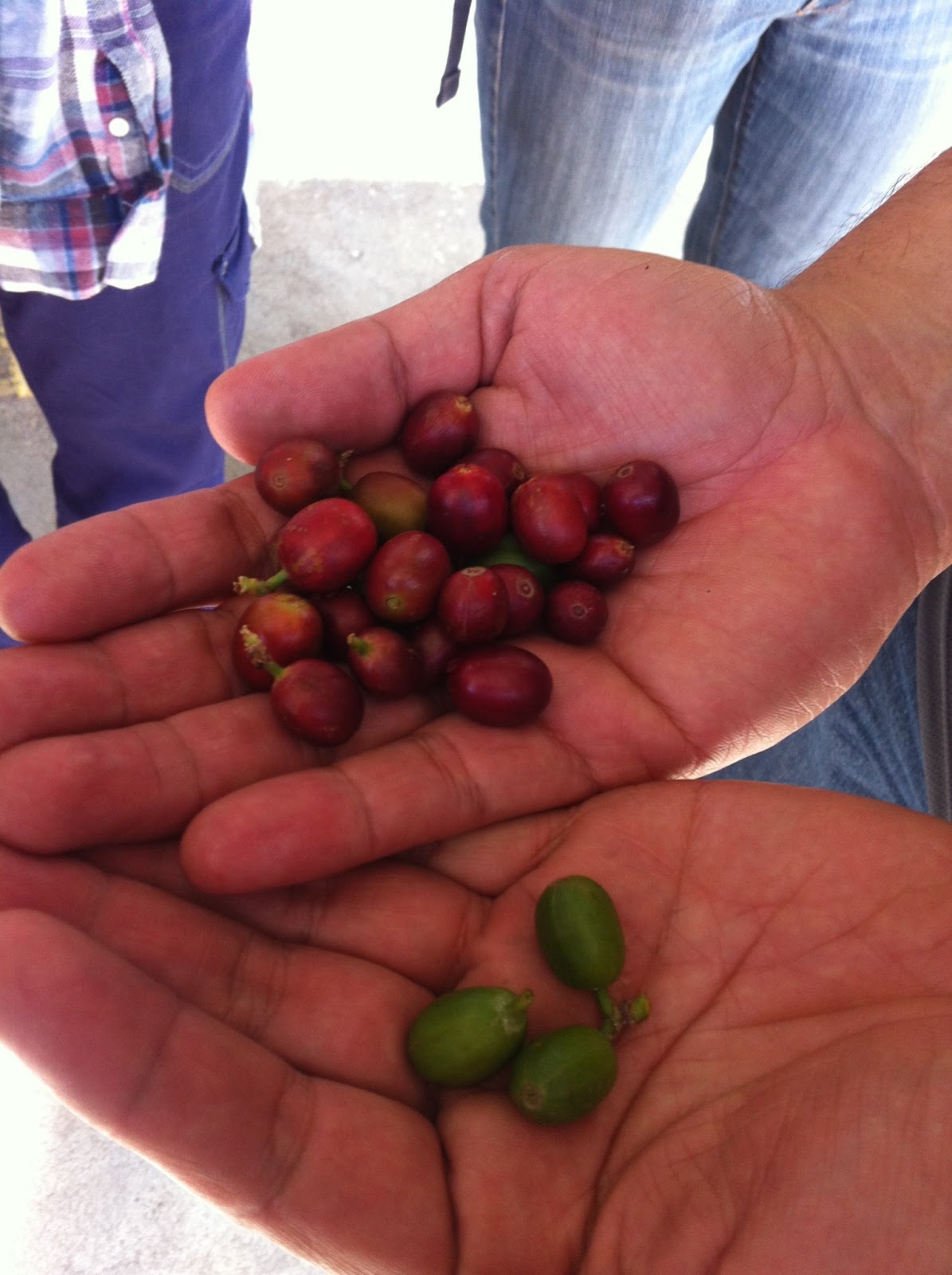
between red and green coffee beans. The
red ones can be peeled and opened, and the green ones cannot, meaning that they
have to be processed as is. The green
ones are usually the ones that get dried and made into instant coffee.
Hace
algunas semanas, mi escuela de español en Xela fue a una viaje de la finca de
café. Nosotros aprendemos como preparar café
y cosas en esto proceso sobre transferencia de calor. Primera, aprendemos que es la diferencia de cafés
rojos y verdes. Podemos abrar los cafés
rojos, pero no podemos abrar los cafés verdes.
Los cafés verdes necesitan preparar como fueron y a menudo estos es lo
que cambiar a café instante.
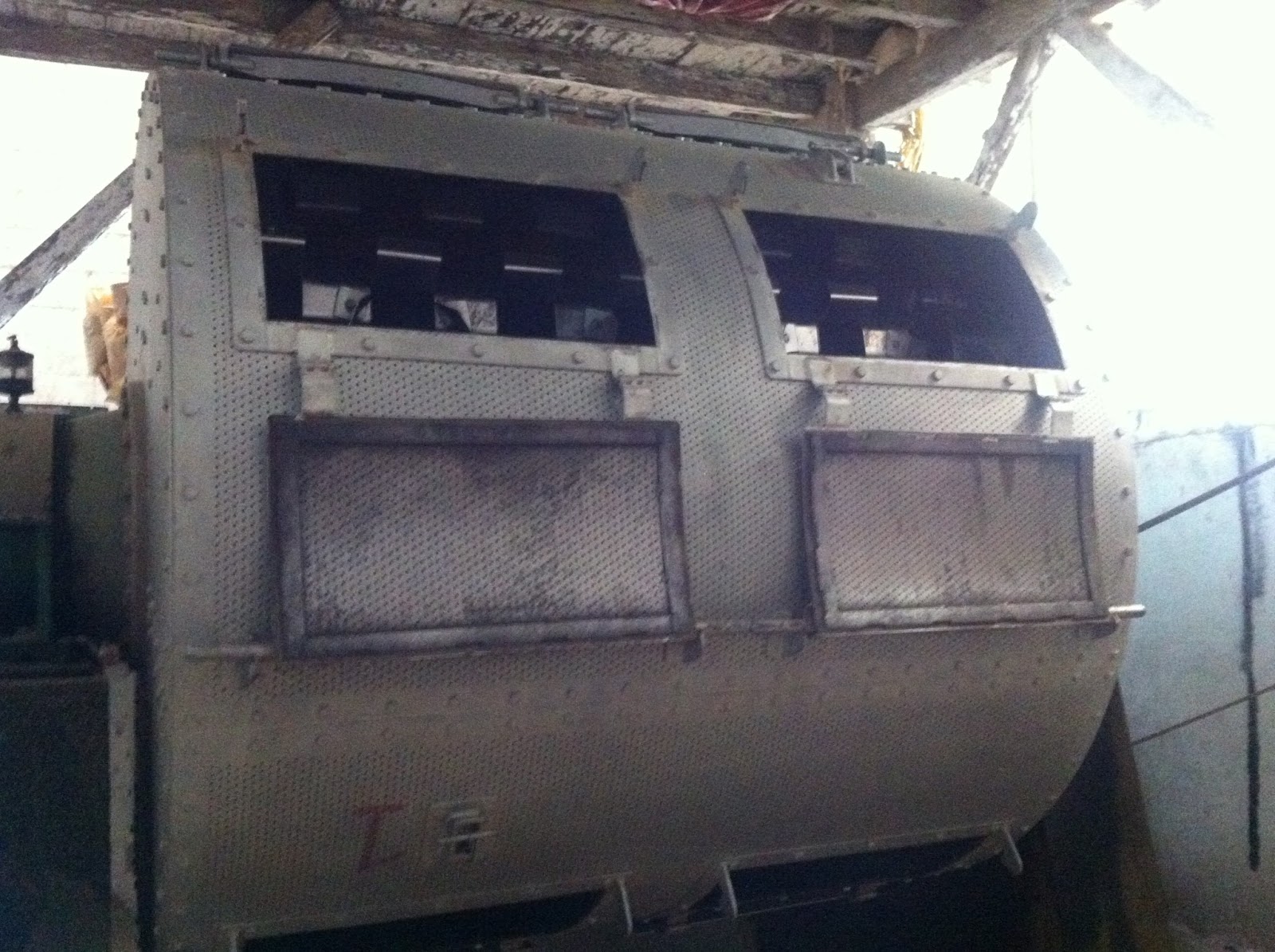
We saw three different methods of drying the coffee beans. One is a machine from Germany (photo below left) , where
the coffee spins in circles while heat is allowed into the system. Another method involves putting the coffee
beans in a large pile above a grate where heat comes in through the bottom, and
workers crawl through the mixture to distribute the heat and let the moisture
evaporate through the top. The last method
is to let the coffee beans dry outside (photo below right), though if there is any chance of rain
overnight these must be collected every night and put back out. The machine from Germany is obviously the best
method because it dried the coffee fast, within hours, and requires minimal
input. The method with the workers
mixing the coffee is bad for the workers’ health, and they are always sick when
working in this process. The coffee
drying outside takes days. I asked why
they don’t just build another machine like the German one. My teacher said he wasn’t sure but it could
be that the plantation owners don’t want to invest in one and take away jobs
for the workers.
Vemos tres opciónes para secar los cafés. La primera opción es una máquina de
Alemania (foto abajo a la izquerda). Los cafés dan vueltas mientras calor entra la máquina. La segunda opción es una caja donde calor
entra en el piso de la caja, y trabajadores caminan en los cafés para
mezclar. La ultima opción es solamente
poner los cafés afuera para secar (foto abajo a la derecha), pero si hay lluvia necesitan mover los cafés
para que los no son mojados. La máquina
de Alemania es mejor porque los cafés secan mas rapido de las otra opciónes y
no necesita mas trabajo. La segunda opción
(como la caja) es muy mal por la salud de los trabajadores y ellos siempre
estan enferma. La ultima opción (los
cafés afuera) es muy lento. Yo pregunté
‘¿porque ellos no construyen una otra máquina de Alemania?’ Mi maestro respondó ‘es una buen pregunta’ y
el dijo posiblemente porque los dueños no lo queren y quieren trabajos por mas
personas.

The final dried coffee beans of the best quality are the
whitest ones, as shown below. Almost all
of the good coffee coming from Guatemalan coffee plantations are exported.
La ultima paso de los cafés mejores es en la foto abajo
donde son muy blancos. La mayoria de los
cafés mejores venden en otra paises.

Monday, February 4, 2013
Technology distribution models
It was interesting to learn about the different distribution
models for the stoves in Guatemala . Recall that the Spanish school developed a
very cheap and easy safe stove that could be provided to families for little to
no cost. The company I volunteered with
had a different model, of selling the stove to families, and any family could
purchase one, and while the costs were on the higher end, the families could
pay in payment plans where each month their fee was estimated to be equal to
the amount that they would typically pay for extra wood for a
non-fuel-efficient stove.
Es muy
interesante aprender sobre las diferente modelos de distribución por las
estufas en Guatemala. La estufa de la
escuela tenía una deseño por la estufas que es muy barrato y facil. Entonces las familias podían recebir las estufas
por menos o nada cuesta. Las estufas de
la compania distribieron con un otra modelo.
La compania vendía estas estufas a alguien familia. La cuesta era mas de un tradicional estufa,
pero las familias podía pagar un poco cada mes, y la cuesta por una mes es la
misma de la cuesta por la leña por un estufa tradiciónal.
Neither of these models are better. They each have tradeoffs and serve different
markets, and having both types of models helped ensure a larger population of
Guatemalans with safe stoves. Sustainable
distribution models for safe stoves, and other types of technologies for
improving quality of life in rural areas, are sometime more difficult that the
engineering of the technologies, though often these concepts are
intertwined.
No modelo
es major. Cada modelo tiene un diferent
propósito y cada modelo tiene intercambios.
Mas modelos es mejor por los Guatemaltecos porque mas familias reciben
estufas. Modelos de distribución que son
sostenible de estufas y otra tipos de tecnologia es una problema y a menudo
haciendo un bien modelo es mas dificil que la deseño de ingenieria, pero ambos
son conectado.
When I was talking with my Spanish teacher in Guatemala
about energy in his country, I asked about why wind and solar energy was so
rare. His answer was that these
technologies are very expensive.
Cuando yo hablaba con my maestro de español sobre energía en
Guatemala ,
lo pregunté porque no hay mucho energía de viento y sol. La repuesta era que estes tecnologias son muy caro.
WindAid, the organization in Peru that I am currently working
with, has come up with several models for distributing wind energy to communities
without power. WindAid has a basic
volunteer program that includes training in manufacturing their wind turbines,
and almost half of the volunteer fees goes to pay for a wind turbines for a
home or community area without power in Peru , and the people without power
get these wind turbines at no charge. During
my first week in Peru , I
helped install one of these 500 W wind turbines at a beach restaurant in Sichura , Peru

This restaurant was in a beach area that is popular with the
locals, and before the turbine was installed, this restaurant and all others in
the vicinity had to rely on batteries to use lights, radios, etc. The wind turbine will now allow the owner to keep
his restaurant open later at night with music and lights.
This type of social entrepreneurship where volunteers
provide much of the funds for these technology projects has the potential to
work well on a small scale. But WindAid
has also come up with other methods to get wind turbines out to communities who
need power. This beach restaurant was
chosen to receive a wind turbine in part, I think, because it would be a great
spot for publicity of the organization and their wind turbines. We posted fliers explaining wind energy at
the restaurant, and we did indeed get a lot of curious beach goers come by and
ask questions about it. The flyers
encouraged people to contact WindAid, and I assume will lead to more purchases
of wind turbines, more communities inquiring about obtaining a turbine, and
hopefully more financial support into the program.

WindAid does also sell wind turbines, so clean energy (energía
limpia) can go out to more locations.
Furthermore, the organization is also working with another organization
to provide the wind turbines for free, and then after the community uses it for
a month or so to see how it can help improve the quality of life by enabling
children to study after dark, people to charge cell phones, etc. a device will
be installed to charge the users for each kW-hr they use at a very low
cost. They theory is that after enough
time, the cost of the wind turbine will be paid for, and thus this becomes a
sustainable distribution system of wind turbines.
Sunday, February 3, 2013
Energy in Peru
I’m still in the process of analyzing all of the stove data
I collected, but will have to do that in Peru since I’ve moved on to additional
interesting projects.
I got picked up by this vehicle in Piura , Peru Peru are natural-gas-gasoline
hybrids, and in the big cities, it’s very easy to find natural gas for purchase
which is much cheaper than gasoline, and the gasoline tank can still be used in
the mountains.

Our first stop, after picking up a piece of wood (madera ) to mount the
turbine on to, was to a community where one of these 500 W turbines had already
been installed. These turbines are about the perfect size for a single
multi-person household without electricity from the grid, and these turbines
can generate enough electricity to power lights at night and possibly charge
cell phones and sometime even a television. Some of these houses also
have solar panels that are primarily used for charging cell phones, though the
solar panels have a high upkeep since they get dusty frequently, so that's why
the wind energy is great to have (las panales de sol necesitan limpiar con mas
frecuencia, es la razon que energía de viento es mejor).
.jpeg)
This particular house we visited was having problems of the
turbine not reaching its full potential, most likely due to the fact that there
were trees in front causing turbulence (los arboles en frente de la turbina son
una problema). We debated for a while whether the best solution
would be to raise the height of the turbine since wind speed picks up with
altitude, though this would create more problems with vibrations, or to move
the turbine to another location. We even began to think about what
type of cheap tool we could use to measure the vibration force, maybe a smart
phone app of some sort (pensamos lo que herrmienta barrata podemos usar para
medir los vibraciónes, posible una aplicación de telefonos
inteligentes). Another suggestion was put out to cut down the trees
(una otra opción fue cortar los arboles). The final decision was to
move the turbine and make it taller (la ultima decisión fue cambiar el lugar y
hacer mas alto). Since the sun was about to go down when we arrived,
the family was planning to get this started and maybe finished, and we would
return another day if needed (la familia empezará este proyecto y talvez
terminará tambien, y nosotros volveremos si es necesario).
Mas a venir sobre mi primera viaje de instalación en Peru , y terminaré las
estufas tambien. (more to come about my first installation trip in Peru , and I
will finish the stoves too).
Friday, January 25, 2013
Soot
A group of women came to my Spanish school earlier this week
as part of the next group that will receive free or near-free stoves from the
school. Another student and I gave a
talk to this group on “Las estufas y los beneficios para la salud.” As the engineer, I explained about soot from
stoves, and the other student, a medical student, explained about the health
effects: “el humo de las estufas
tradicionales contiene miles de sustancias que con similares [a cigarros] y que
son muy peligrosos para el cuerpo. La peores incluyen la ceniza y hollín que
se forman a causa de combustion en el fuego. Estos cambian el calor de una olla nueva a negro. Y la ceniza y el hollín pueden mezclar con el aire y entran nuestros
cuerpos... (insert medical stuff here)... Las estufas
de la escuela son mas eficientes de las estufas tradicionales. El proceso de combustión in nuestras estufas
es mas completo y las partículas de hollín cambian a gases mas limpias. Entonces el aire es mas limpio tambien.”
Here are some initial results of the soot measurement in the
other stove project that I’ve been volunteering with. This was from my first time lighting the
stove, so this may not be the best gauge of how well the stove is performing. It’s obvious though that even with this
simple diagnostic we can tell that there’s soot forming from the flame. Now to figure out how to reduce the amount
formed.


Before/antes (top/arriba) and after/despues (bottom/abajo)
Wednesday, January 23, 2013
Planning experiments
Understanding the theory of combustion and heat transfer in
a stove can only help so much with the design. To understand the performance of the current
rocket stove design more, experiments need to be performed (experimentos son
necesario para entender como
es la functión de la estufa de cohete). Unfortunately,
we don’t have the funds for laser absorption diagnostics in Xela. So what tools can we use for
experimentation? (No tenemos herrmientas
por absorbción de lasers en Xela. ¿Entonces,
que herrmientas pedemos usar medir cosas en experimentos?)
The company I’m working with has a few tools for
experimentation. I have two
thermocouples, one with a limit near the boiling temperature of water, and one
with a limit of roughly 773 Kelvin. I
can also use an IR temperature sensor to measure surface temperatures on
non-reflective surfaces. Furthermore, I
have access to a scale to measure weight.
What would really be useful would be if I could monitor the air flow
velocity, and that could give me a sense of the air-fuel ratio. Additionally, a method to monitor soot would
be helpful to determine how complete the combustion process is. We started up the stove and played with the
tools we had, and also several other methods of monitoring things. The temperature measurements seem fine. I explored a poor man’s soot diagnostic by
putting a piece of clean pumice stone in the gas flow chamber (la idea gracias
a Adela) – after a few minutes, the pumice stone will begin to darken from the
soot, and using this monitoring technique I may be able to determine whether
more or less soot is formed in different stove configurations. To make more quantitative soot measurements,
a particle counting device can be purchased for about $200, though this won’t
happen in the time that I’m here. We
explored the air flow velocity by lighting another starter stick of wood and
placing it near the air inlet of the stove, and by watching the flame enter the
air inlet we could tell that there was substantial airflow. I doubt this would yield a very good
quantitative measurement of air flow velocity, but maybe by measuring the angle
of the flame entering the air inlet I might be able to determine whether changing
the flow geometry inside the stove has a significant effect on the air flow
velocity.
My planned experiments include time-to-boil tests. In these tests, I will make lots of temperature
measurements and ad hoc soot and velocity measurements. And maybe a tortilla cooking test will occur as
well. (Voy a medir la temperatura en muchos lugares y voy a tratar de medir
hollín y velocidad de aire. Haré un
experimento de cocinar tortillas también).

Results to come. Experimental
suggestions welcome.
Subscribe to:
Posts (Atom)